Blog
Pickleball vs Padel: Key Differences & How to Choose the Right Gear

As racquet sports sweep the globe, Pickleball and Padel have emerged as the two fastest-growing recreational and competitive sports today. While both blend elements of tennis, badminton, and ping-pong—offering a lower barrier to entry than traditional tennis—they differ fundamentally in court architecture, equipment construction, and tactical play.
If you are deciding which sport to try or looking for the ideal gear to start your journey, this guide breaks down everything you need to know across courts, rules, equipment, and playstyles.
⚡ Fast Takeaways: Core Differences at a Glance
- Pickleball: Originating in the United States, played on a badminton-sized court using a perforated plastic ball and solid paddles. Famous for its non-volley zone (“The Kitchen”), emphasizing soft control, dinking, and quick reflexes.
- Padel: Popularized in Latin America and Europe, played in an enclosed court surrounded by glass walls and mesh fence. Utilizes perforated foam-core rackets and permits wall rebounds, resulting in fast-paced, 3D tactical rallies.
1. Court & Environment: Open Hardcourt vs. Enclosed Glass Box
- Pickleball Court: Measures 44 × 20 feet (approx. 13.4 × 6.1 meters)—the same dimensions as a badminton doubles court. Played on an open hardcourt with a 34-inch net height at the center. The defining feature is the 7-foot Non-Volley Zone (commonly known as “The Kitchen”) on both sides of the net.
- Padel Court: Measures 20 × 10 meters, larger than a pickleball court. The defining characteristic is the 3 to 4-meter-high glass walls and metallic mesh enclosure. Ball bounce off the glass walls remains live, allowing wall-assisted defense and tactical counter-attacks.
2. Equipment Comparison: Honeycomb Cores vs. Foam Interiors
The physical gear directly dictates ball feel and control dynamics:
- The Ball: Pickleball uses a lightweight, hard plastic ball with drilled holes (26 holes for indoor, 40 holes for outdoor). Padel uses a pressurized rubber ball visually similar to a tennis ball, but with lower internal pressure.
- Paddle vs. Racket:
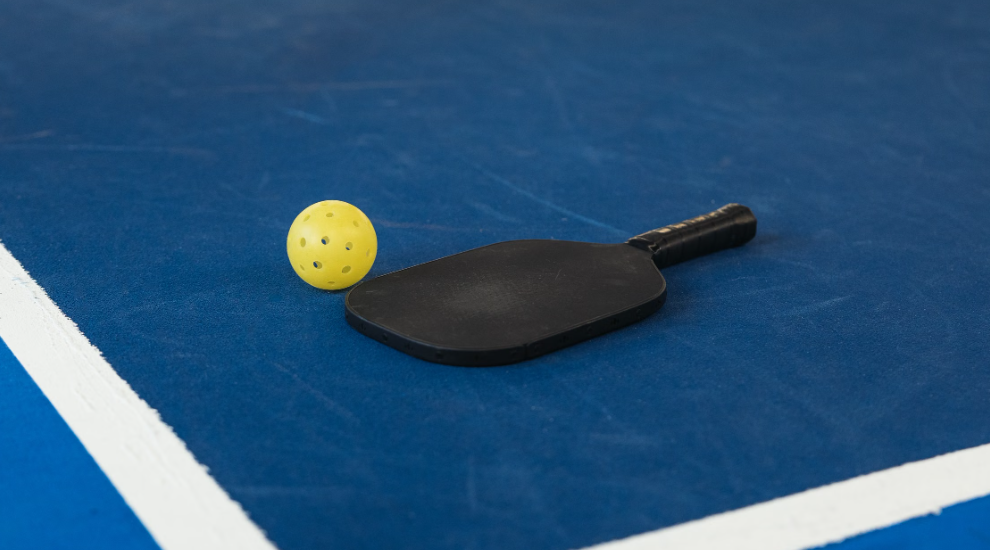
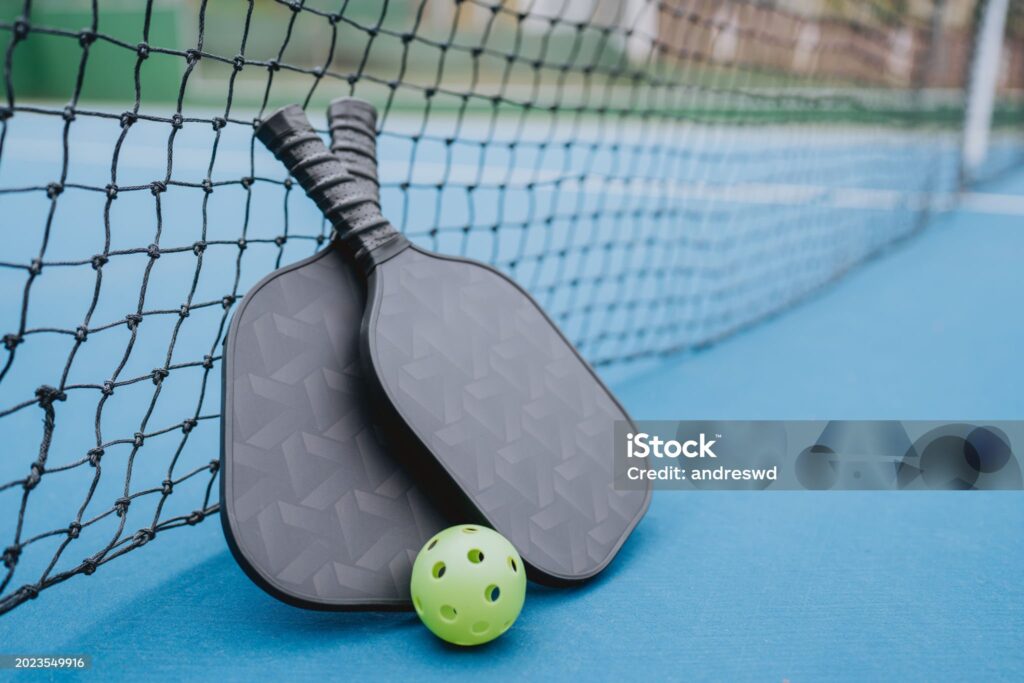
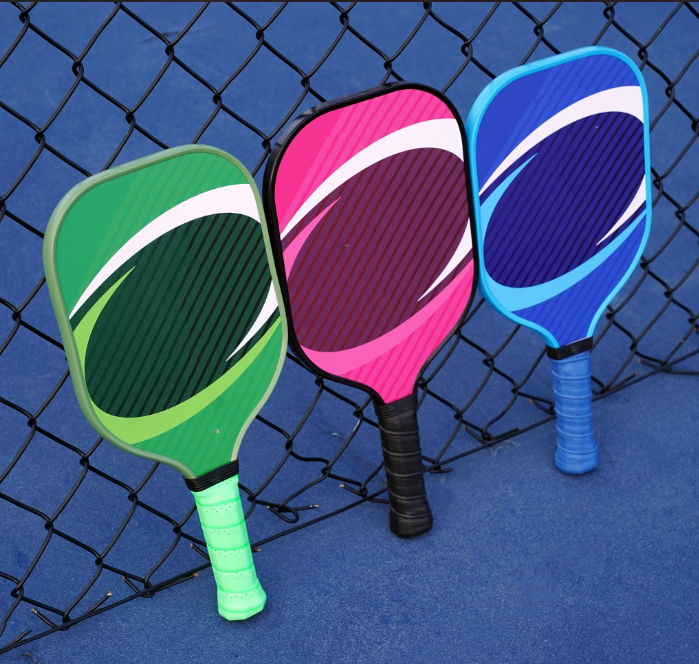
- Pickleball Paddles: Solid, flat-faced paddles with no holes, constructed around a Polymer Honeycomb Core. Advanced high-performance models—such as the Raw Carbon Fiber series developed by Jeimor—feature T700 raw carbon faces that maximize spin generation, power transmission, and ball feedback while keeping weight minimal.
- Padel Rackets: Thicker profile (typically 38mm) with ventilation holes drilled across the face, utilizing EVA foam interiors to absorb high-velocity impacts.
3. Gameplay Mechanics & Rules
Pickleball: Tactical Precision & Dinking
- Underhand Serve: All serves must be hit underhand, contacting the ball below waist height.
- Two-Bounce Rule: The serving team and receiving team must each allow the ball to bounce once before volleying is allowed.
- Kitchen Rules: Players cannot step on or inside the Kitchen line while making a volley, turning net play into a strategic battle of soft drops, dinks, and patience.
Padel: Wall Rebounds & Spatial Angles
- Underhand Bounce Serve: Serves are hit underhand after letting the ball drop and bounce once behind the service line.
- Wall Play: Players can utilize glass walls to let the ball bounce and play it back, creating deep defensive options.
- Scoring: Follows traditional tennis scoring (15, 30, 40, Game) and is almost exclusively played in doubles formats.
4. Pickleball vs. Padel: Feature Comparison Table
| Feature | Pickleball | Padel |
| Origin | United States (1965) | Mexico (1969) / Europe |
| Court Size | 13.4m × 6.1m (Open hardcourt) | 20m × 10m (Enclosed glass walls) |
| Paddle / Racket | Solid face, honeycomb core | Perforated face, EVA foam core (38mm) |
| Ball Type | Perforated hollow plastic ball | Low-pressure rubber felt ball |
| Primary Skill | Kitchen positioning, dinking, reset drops | Wall angle reading, smash positioning |
| Primary Format | Singles & Doubles | Doubles dominant |
| Learning Curve | Extremely fast (15 mins to rally) | Fast (Requires adjusting to wall rebounds) |
5. How to Choose & Equipment Recommendations
Choose Pickleball if you prefer low-impact, highly accessible gameplay with rich tactical finesse and flexible singles or doubles play. Choose Padel if you enjoy dynamic wall rebounds, fast-paced exchanges, and consistent 2v2 play.
💡 Expert Gear Tip:
Regardless of the sport, selecting a paddle with high vibration dampening and precise touch is crucial for protecting wrist joints and improving placement accuracy:
- Beginners: Opt for mid-weight paddles (7.8–8.2 oz) with comfortable, cushioned grips.
- Intermediate & Advanced Players: Look for textured carbon fiber faces. For example, Jeimor engineers its pickleball paddles with precision-tuned honeycomb cores and shock-absorbing handle tech, delivering exceptional vibration control to safeguard elbows during prolonged exchanges while ensuring crisp shot feedback at the net.
Starting with the right equipment not only minimizes injury risks but also lets you feel every clean hit from day one.