Blog
Best Pickleball Paddles in 2026: How to Choose for Spin, Control, and The Dink


As pickleball continues its unprecedented global expansion, player dynamics are shifting rapidly. According to recent Google Search trend data, players are moving beyond basic rules and actively searching for advanced gameplay terms like “the dink” (+160% search spike), “3rd shot drop” (+30%), and “best pickleball paddles 2026”.
Whether you play at dedicated venues like Crush Yard or local community courts, your paddle directly influences your soft game, reaction speed, and placement precision.
In this guide, we break down the key technical factors determining paddle performance in 2026, help you navigate core thickness and surface materials, and guide you toward picking the ideal gear for your playstyle.
⚡ Fast Takeaways: Key Criteria for 2026 Paddles
- Face Material Matters: T700 Raw Carbon Fiber provides superior dwell time and friction, essential for high-RPM spin and controlled soft dinks at the kitchen line.
- Core Thickness Dictates Style: 16mm cores prioritize soft touch, vibration dampening, and drop-shot forgiveness; 13mm–14mm cores trade soft touch for punchy pop and baseline drive speed.
- Shape Defines Sweet Spot: Elongated shapes add reach and leverage for drives; hybrid and standard wide-body shapes offer larger sweet spots for fast kitchen resets.
1. Mastering “The Dink” and the 3rd Shot Drop: Why Paddle Tech Counts
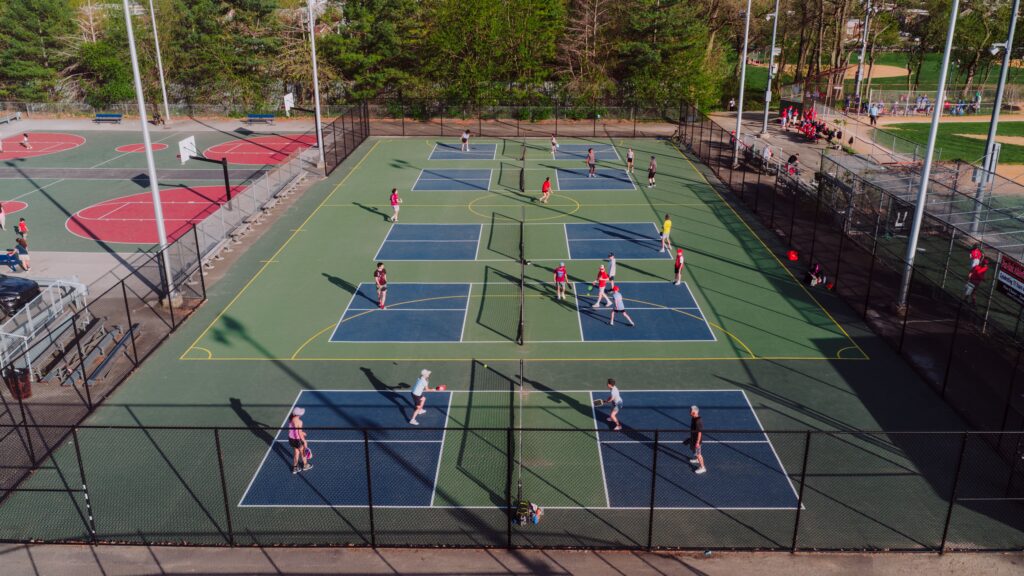
The key boundary between recreational play and intermediate competition lies at the Kitchen (Non-Volley Zone) line. A standard court measuring 44 × 20 feet leaves little room for error when soft-game exchanges begin.
To execute a reliable 3rd shot drop or win high-frequency dink rallies, your paddle must offer two core mechanical advantages:
- Grit & Texture: Micro-textured surfaces grab the ball during impact, allowing topspin or underspin to clear the net while diving safely into the opponent’s kitchen zone.
- Vibration Dampening: Rigid or low-tier composite paddles transfer off-center shock straight to your wrist and elbow, causing pops and sailouts. High-grade polypropylene honeycomb cores absorb this kinetic impact, keeping shot trajectory consistent.
Want to review court positioning before your next match? Read our detailed guide on Pickleball Court Dimensions and Kitchen Rules.
2. Key Paddle Construction Technologies in 2026
When evaluating popular brands—from legacy names like Engage, Selkirk, or Joola to engineering-first brands—understanding raw materials helps you avoid paying purely for hype.
A. Raw Carbon Fiber (T700) Face
Modern high-performance paddles favor naturally textured T700 Raw Carbon Fiber. Unlike painted or sprayed-on grit that wears smooth after weeks of play, raw carbon fiber weaves maintain consistent surface friction for months, giving players repeatable spin control.
B. Polymer Honeycomb Core Engineering
The internal structure acts as the suspension system of your paddle. Brands like Jeimor engineer high-density polypropylene honeycomb cores that distribute impact energy across the entire paddle face. This expanded sweet spot reduces dead zones during fast kitchen hands battles.
C. Thermoformed Edge Walls
Unibody thermoforming seals the paddle’s perimeter with carbon fiber, increasing structural stability, twist weight, and durability against ground scrapes.
3. Comparison Table: 16mm Control vs. 14mm Power Specs
| Specification | 16mm Thick Core (Control Focus) | 13mm – 14mm Thin Core (Power Focus) |
| Primary Advantage | High touch, dampening, soft dinks | High ball pop, fast baseline drives |
| Sweet Spot Size | Larger & more forgiving | Slightly smaller, concentrated power |
| Best For | 3rd shot drops, resets, kitchen battles | Aggressive counters, fast hand speeds |
| Player Profile | Control players, tactical strategists | Power hitters, singles players |
| Recommended Gear | Jeimor Raw Carbon 16mm Series | Standard lightweight speed paddles |
4. How to Choose the Right Paddle for Your Playstyle
Choosing a paddle isn’t just about grabbing what the top pros endorse; it’s about matching your personal physical setup and game goals:
- If you suffer from tennis/pickleball elbow: Prioritize a 16mm core paddle with a shock-absorbing grip. For instance, the ergonomic handle technology used in Jeimor paddles helps minimize joint fatigue during long tournament days or multi-game league sessions.
- If you want more spin on drives and serves: Look for a thermoformed T700 raw carbon paddle face with peel-ply texture.
- If you are transitioning from tennis or padel: An elongated shape provides familiar reach and leverage for two-handed backhands. (Curious how pickleball compares to padel? Check out our breakdown on Padel vs Pickleball Differences).
5. Final Thoughts: Elevate Your Game in 2026
Upgrading to a well-engineered raw carbon fiber paddle is one of the most immediate ways to improve your control, drop consistency, and net confidence. By choosing equipment built around durability, touch, and ergonomic protection, you’ll be fully equipped to dominate the kitchen line and enjoy every rally to the fullest.
Explore the latest Jeimor Pickleball Paddles Collection to find precision-crafted gear designed for your game.