




Blog
Pickleball Paddle MOQ Explained:

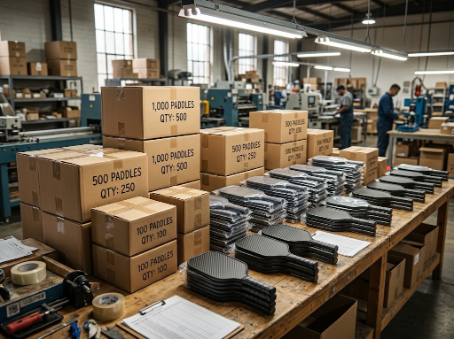
Why 100, 500 and 1,000 Units Cost Different
Minimum order quantity is the number most likely to end a promising supplier conversation — and the number most often misunderstood. MOQ is not a policy a factory invents to feel important. It is arithmetic, and once you can see the arithmetic you can usually negotiate around it.
Where an MOQ actually comes from
Four costs behave differently at different volumes, and the highest of them sets the floor:
- Material minimums. Carbon cloth and honeycomb core are bought by the roll or by the sheet. If a factory must buy a full roll to make your face material, the roll size sets a hard floor regardless of what anyone promises.
- Setup and tooling. Print plates, moulds and press programming are one-time costs per design. At 100 units they dominate unit price; at 1,000 units they are background noise.
- Press scheduling. A thermoforming cycle occupies a press for a fixed window. Small runs interrupt scheduling for larger accounts, which is why very small orders get quoted at unattractive prices rather than refused.
- Labour learning curve. The first 50 units of any new specification run slower and with more scrap than the next 500. Factories price that risk in.
The three-tier structure you will usually see
Most competent paddle factories operate a structure roughly like this: a trial tier for new specifications where the price per unit is high but the quantity is low; a standard production tier at a materially better unit price; and a container tier where freight optimisation and material buying combine to give the best landed cost. The gaps between tiers are not linear — the drop from trial to standard is usually steep, and the drop from standard to container is shallower.
What this means for a first order
Your objective on a first order is not the lowest unit price. It is the lowest total risk. That usually means the trial tier, even though the unit price looks bad, because the cost of discovering a specification problem at 1,000 units is far higher than the premium paid at 200.
Five ways to lower an MOQ without lowering quality
- Combine colourways. Ask whether mixed colours count toward one production minimum. Most factories will allow it; some will not, and the ones that will are usually the ones with in-house printing.
- Combine models that share a core. A 13mm and a 16mm version of the same shape often share tooling and can be run together.
- Use an existing mould. A proprietary shape requires new tooling and therefore a higher minimum. A stock shape with your graphics does not.
- Accept a standard packaging option for the first run. Custom boxes carry their own minimum, often higher than the paddle minimum itself.
- Split the difference with a stock-and-label arrangement. Some factories hold neutral finished goods and apply your branding on receipt of a smaller order. Confirm what the lead time penalty is.
Red flags in MOQ conversations
An MOQ of 10 units with no price penalty is not generosity — it means stock product with your logo printed on it, which means no control over core, face or construction. An MOQ that changes every time you ask is a sign the supplier is quoting through an intermediary. And an MOQ quoted without reference to your specification at all is a number, not a quote.
How to ask the question properly
Instead of asking what the minimum is, ask: what is the minimum for this specification, with this packaging, in these three colourways, and what would the unit price be at the next quantity break? That single question gives you three data points instead of one, and it tells the supplier you understand where their costs sit.
CTA:Tell us your specification and your realistic first-year volume, and we will quote two quantity breaks side by side so you can see exactly where the cost steps down.