




Blog
Custom Pickleball Paddle Branding: What Can Actually Be Customized

OEM & Private Label
Custom Pickleball Paddle Branding: What Can Actually Be Customized (and What Each Option Really Costs)
Quick answer
- Nearly everything on a paddle can be customized — the honest question is what each option costs in tooling, unit price and lead time.
- Graphics on an existing mold need no tooling. A new shape needs new molds — the biggest one-off cost in the category. Most brands customize graphics first, tooling second.
- UV printing vs laser engraving: full-color anywhere vs permanent minimalist marking. Both are production-standard.
- The customization nobody prices early: packaging. Retail-ready boxes, inserts and FBA prep are per-unit line items that decide your landed cost more than most paddle options.
- Mockup speed is a real capability signal: factories that produce design mockups in about a day run their own art and print lines; factories that outsource finishing cannot.
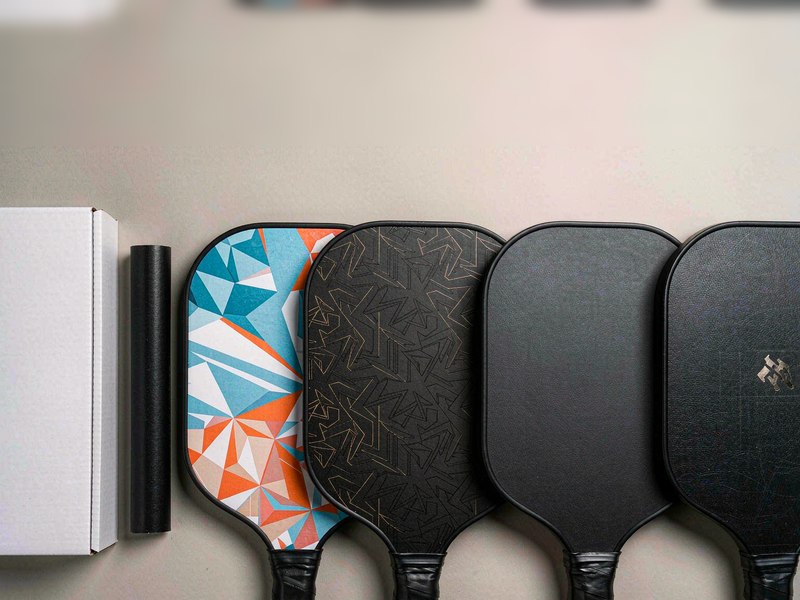
“Custom pickleball paddle” covers everything from a logo printed on a stock model to a ground-up paddle with its own mold, texture and packaging. Buyers who treat these as one product get quoted inconsistently and compare prices that aren’t comparable. This guide walks through every customizable part of a paddle in the order a factory actually makes those decisions — what each option involves, what it costs beyond the unit price, and where brands routinely overspend.
The numbers that follow a customization decision — unit cost, MOQ, lead time — are covered in our private label cost breakdown and MOQ guide. Here we stay on the options themselves.
The customization ladder
Think of customization in three tiers, because the factory’s cost structure changes completely between them:
| Tier | What changes | Tooling | Typical use |
|---|---|---|---|
| 1. Branding on a platform | Graphics, edge guard color, grip logo, packaging | None (print setup only) | First product, marketplace sellers, club and corporate programs |
| 2. Specification on a platform | Core thickness, weight band, face material, finish, cover | None to minor | Second-generation products, differentiating SKUs |
| 3. Ground-up custom | Paddle shape, mold, construction, everything above | New molds — the major one-off cost | Proven brands, flagship models, performance lines |
The ladder matters because each tier multiplies lead time and minimums. A tier-1 program samples in days and ships in weeks; a tier-3 program adds mold fabrication before a single paddle exists. Brands that need a market presence this quarter should start at tier 1 and earn their way to tier 3 — the order data from a platform product is exactly what makes the tooling decision safe later.
Part by part: what can be customized
Face graphics — UV printing
The standard method for full-color logos and designs. UV-cured ink prints directly on the finished face, handles gradients and photography, and reproduces consistently across a production run. The one real trade-off, covered in our face materials guide: printed layers sit between the molded texture and the ball, so heavy all-over graphics cost some surface longevity. Well-run programs keep graphics clear of the primary hitting zone or accept the trade knowingly.
Face branding — laser engraving
Laser marking removes material microscopically to leave a permanent mark — no ink, nothing to wear off, and the molded texture stays intact around the mark. It suits minimalist logos, model names and spec engravings, and pairs with a raw-carbon aesthetic. Many brands combine both: engraved wordmark plus a printed graphic away from the sweet spot.
Surface texture and finish
Texture is a mold decision, not a print decision — the peel-ply texture that gives raw carbon its grip is pressed in during curing. Within one mold, you can still choose finish (matte, semi-gloss, gloss) and how much of the face is covered by print. Brands wanting maximum spin performance should spec raw faces with minimal coverage and put branding at the edges — this is a customization constraint worth knowing before the art is designed, not after.
Edge guard and end cap
Edge guard color is one of the cheapest visual differentiators available — a colored edge on a black paddle reads as a distinct model from three meters away, for almost no setup cost. End caps can carry a molded or engraved logo. If your brand has one signature color, this is where it earns its keep.
Grip
Grip material, thickness, wrap style and printed logos on the wrap itself. Grip customization also affects the weight and balance — worth specifying together with the weight band rather than after (our weight guide covers why grip is the cheapest balance-tuning lever).
Construction within a platform
Core thickness, face material and weight band can be varied on an existing mold — this is tier 2. It is how brands produce a “control” and a “power” SKU from one tooling investment: same shape, different core and face spec. The construction options are covered in depth in our core types guide.
Shape — the tier-3 decision
A new shape means new molds: the largest one-off cost in the category, plus a longer sampling cycle. It is also the most defensible differentiation once you have it, because a competitor can copy your graphics in a week and your shape only with their own tooling. The shape decision itself — elongated vs standard vs hybrid — is covered in our shapes guide; here the point is sequencing: earn the tooling with tier-1 sales data before committing to it.
Packaging and retail readiness
The customization most brands under-think. Paddle covers (material, color, logo), retail boxes, inserts, hang tags and barcodes are per-unit line items — often a larger share of the landed cost than the branding on the paddle itself. Two rules from experience:
- Spec packaging with the paddle, not after. Late packaging decisions delay shipments more than any paddle option.
- Match packaging depth to channel. Marketplace cartons and boutique retail boxes are different products with different costs. Over-packaging a channel that throws boxes away is pure margin loss.
Fulfillment prep
For marketplace sellers, factories running their own print and packing lines can ship FBA-ready: FNSKU labels applied, polybag and suffocation-warning requirements met, master cartons built to FC spec. This removes an entire handling step between factory and shelf. The prerequisite is confirming prep requirements in writing before production — retrofitting FBA compliance after packing is exactly as painful as it sounds.
A factory that produces design mockups in about a day runs its own art department and print line — the people quoting your job will also print it. A factory that takes a week for a mockup is brokering your customization to subcontractors, and every option on this page passes through more hands than its quote suggests. Response speed on a free mockup is the cheapest capability audit in custom manufacturing.
Where brands overspend
- Tooling before traction. New-shape molds on a first product, before any order data exists. The graveyard of paddle brands is full of beautiful custom molds.
- All-over graphics on a performance face. Paying for raw carbon and then covering it in ink is paying for texture and then burying it. If the brand story is spin, keep the hitting zone clean.
- Six SKU variants at launch. Two or three colorways of one proven model beat six models with no reviews — customization scales with demand, not ahead of it.
- Boutique packaging for marketplace channels. Spend the packaging budget where the customer sees it.
A sensible first customization plan
- Pick a proven platform (shape, core, face) close to your target spec.
- Customize graphics, edge guard and grip — no tooling, fast sampling, full brand presence.
- Spec retail-ready packaging for your actual channel — and FBA prep if that is the channel.
- Sample, run the pre-order checks, then commit the first production run.
- Reserve new tooling for generation two, when order data — not enthusiasm — justifies the molds.
This sequence gets a brand fully custom-looking product in weeks, at a fraction of the exposure of a ground-up program, and builds exactly the data that makes the eventual tooling decision safe. The full path from concept to first container is laid out in our brand launch guide.
Frequently asked questions
What parts of a pickleball paddle can be customized?
Practically everything: face graphics, texture and finish, edge guard color, grip, end cap, core thickness, weight band, shape (with tooling), cover and packaging. The real question is what each option costs in tooling, unit price and lead time.
How much does custom paddle tooling cost?
Graphics on an existing mold need no tooling. A new shape needs new molds — the largest one-off cost in the category, quoted per project. Most brands customize graphics first and reserve tooling for a proven generation two.
Can I put my logo on a pickleball paddle?
Yes — UV printing for full-color logos anywhere on the face, or laser engraving for permanent, ink-free marking. A design mockup normally precedes sampling.
What is the minimum order for custom pickleball paddles?
Lower for branding on an existing platform than for new tooling, because graphic setup amortizes across the run. Factories with in-house molding and printing support smaller programs than those that outsource finishing.
Can custom paddles ship directly to Amazon FBA?
Yes — FBA-ready programs apply FNSKU labels, meet polybag requirements and build master cartons to FC spec so cartons move from factory floor to fulfillment center without re-handling. Confirm prep requirements in writing before production.
See your branding on a paddle before you commit
Send your logo and a target price point — we will return a mockup, the realistic customization options for your budget, and honest trade-offs, including which ones to skip.