




Blog
How to Start a Pickleball Paddle Brand in 2026: From Concept to First Container

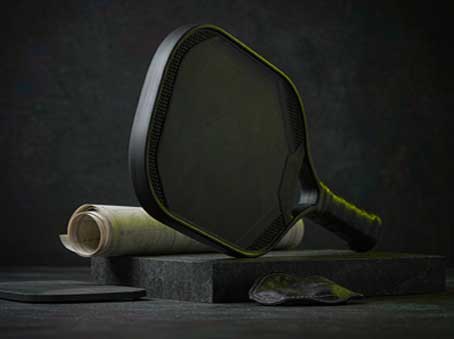
The barrier to launching a paddle brand has never been lower. The failure rate has never been higher. Most first-time brand owners do not fail on marketing — they fail on three decisions made in week one: what material to build on, which factory to trust, and how much to order. This guide walks through the sequence that works, in the order the decisions actually have to be made.
Step 1 — Decide which price tier you are entering, before anything else
Retail paddles in North America now cluster into four bands, and each band has a different material logic:
- Under $60 — fiberglass face, honeycomb core, cold press. Volume product, sold on color and price.
- $80–130 — fiberglass or composite face with better edge construction. The most crowded band, and the hardest to enter without a story.
- $150–220 — raw carbon face, 16mm core, often thermoformed. This is where brand identity starts to matter.
- $230+ — thermoformed raw carbon, edgeless or near-edgeless construction, pro endorsement. Not a first-order tier.
Pick your tier first, because the tier determines your material, your MOQ, and your packaging budget. Brand owners who choose the material first — usually because a factory quoted them a good price on carbon — end up with a $180 product trying to compete in a $90 shelf position.
Step 2 — Choose face material and construction as two separate decisions
Buyers often treat these as one choice. They are not. Face material (fiberglass, raw carbon such as Toray T700, or a composite) controls spin, feel and cost. Construction (cold press versus thermoformed) controls consistency, edge durability and how the core behaves after 200 hours of play. A fiberglass paddle can be thermoformed. A raw carbon paddle can be cold pressed. The four combinations sit at very different price points and have very different return rates.
Step 3 — Separate real factories from trading companies
Most suppliers you will find on sourcing platforms are trading companies. That is not automatically bad — some add real value in QC and logistics. But you should know which one you are talking to, because it changes your cost structure and your ability to customise. Four questions that separate them quickly:
- How many hot presses do you operate, and what is the platen size? A trading company cannot answer this with a number.
- Can you send a live video walk-through of the pressing line today, not a stored clip?
- When a batch fails a bounce or deflection check, what happens to it? Factories have a scrap rate. Traders change the subject.
- Which components do you make in-house, and which do you buy in? Edge guards, cores and printing are commonly outsourced even by real factories.
Step 4 — Sample two or three configurations, not one
A single sample tells you whether the factory can make one paddle. It does not tell you whether they can make it repeatedly. Order two or three configurations — for example 13mm versus 16mm core, or fiberglass versus raw carbon face — and put them in the hands of at least five players at different skill levels. Sample turnaround from a competent factory runs about 7 to 15 days, and you should expect to pay for it. Free samples almost always mean a stock model pulled off a shelf, not something built to your spec.
Step 5 — Get the compliance language right, because buyers will check
USA Pickleball publishes and maintains the official equipment list for sanctioned play. If your paddle is on that list, say so, with the listing reference. If it is not yet listed, the accurate claim is that the paddle is built to meet USA Pickleball specifications — never that it is approved. North American retail buyers verify this before they place a purchase order, and a single overstated claim ends the conversation permanently. The same discipline applies to CE, REACH and California Prop 65 documentation: supply the test reports, do not just assert compliance.
Step 6 — Structure the first order as a test, not a volume play
Your first order exists to prove three things: that the product sells at your target price, that the factory ships what it promised, and that your packaging survives a fulfilment centre. Size it accordingly. Most new brands are better served by a smaller first order across three or four colourways than a large order in one. Ask explicitly how mixed colours and mixed models affect the minimum — a good factory will let you combine SKUs to reach a production minimum rather than forcing a single-SKU commitment.
Step 7 — Plan replenishment before you sell out
The most common first-year failure is not a bad paddle. It is a brand that sells out in week six and reorders into a 30-day production queue plus a 30-day ocean transit, leaving an eight-week gap with no stock. Before you launch, map your production lead time, your transit time and your safety stock as one number. If your factory holds finished inventory in a US warehouse, that changes the maths substantially — but confirm exactly which warehouse, and whether it can serve your channel, because fulfilment-centre inventory and bulk wholesale inventory are not the same thing.
A realistic first-year sequence
- Weeks 1–2 — Tier and material decision. Competitor teardown of five paddles in your target band.
- Weeks 3–5 — Factory shortlist and verification. Request video walk-through, certifications, and two references.
- Weeks 5–7 — Samples in hand, player testing, packaging design started in parallel.
- Weeks 8–10 — Compliance documentation, artwork approval, first purchase order.
- Weeks 11–16 — Production plus ocean freight. Use this window for content, listings and pre-launch, not for waiting.
- Week 17 — First stock lands. Reorder decision should already be made by week 20.
What actually separates brands that survive year one
Not the paddle. Almost every paddle in a given tier performs within a narrow band, and customers cannot reliably tell two 16mm thermoformed raw carbon paddles apart in a blind test. What separates brands is whether the second order arrives on time, whether the colour matches the first batch, and whether the factory answers a defect claim in days rather than weeks. Choose your supplier on those three things, and the product decision becomes much less risky.
CTA:If you are at the tier-and-material stage, we can send our current spec sheet with core thickness, face material, swing weight and edge construction for each model, plus real production lead times. Request it here and tell us which price band you are targeting.
Request