




Blog
Pickleball Paddle Core Types: How Core Material, Cell Size and Thickness Shape Performance

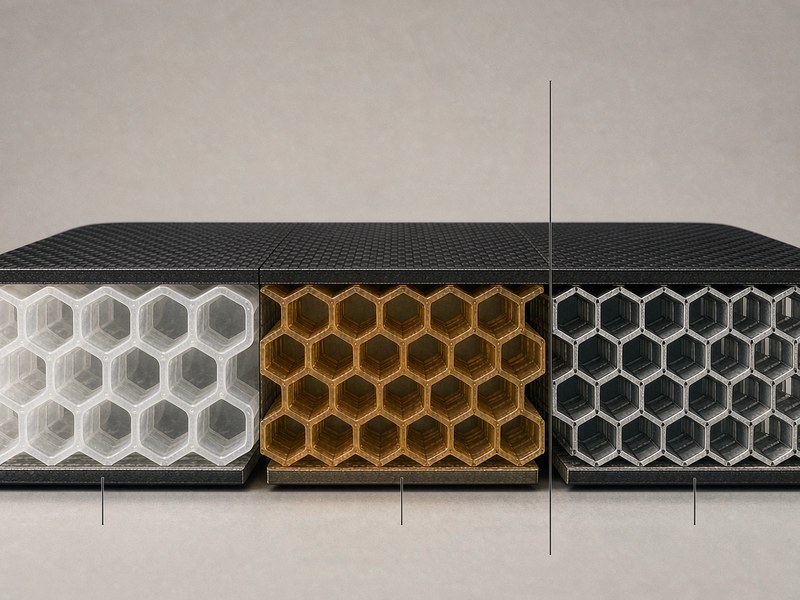
Pickleball Paddle Core Types: How Core Material, Cell Size and Thickness Shape Performance
-
- Four core families matter in 2026: polymer honeycomb (the default), Nomex aramid honeycomb (power niche), aluminum honeycomb (legacy), and foam or foam-hybrid cores (the emerging premium segment).
-
- Polymer honeycomb dominates because it balances three things at once: control, vibration damping and manufacturing scalability. Nomex is stiffer and louder; aluminum is largely obsolete.
-
- Cell size changes feel more than most buyers expect: smaller, denser cells feel firmer and more responsive; larger cells feel softer and more forgiving.
-
- Core thickness is the biggest single lever: 16 mm plays plusher and more forgiving, 13–14 mm plays snappier and more powerful. Most current paddles cluster at these two thicknesses.
-
- Core material alone does not pick a paddle. Thickness, face material and construction method (see our thermoformed vs cold-pressed guide) all modify the result.
Quick answer
Face material gets the marketing attention, but the core is the part of a pickleball paddle doing most of the work. It is the honeycomb or foam layer sandwiched between the two face sheets, and its material composition — plus its thickness and cell geometry — shapes power, control, sound, vibration and long-term durability more than almost any other single specification.
This guide covers the four core families used in current production, the variables that exist within each family, and how to match a core specification to a target player segment. It is written for two audiences at once: players choosing a paddle, and brands specifying one for manufacture. The vocabulary is the same for both — and it is the vocabulary we use internally on every development project.
What does the core actually do?
Paddle core
The structural layer between the two face sheets of a pickleball paddle. In most modern paddles it is a honeycomb lattice of thin walls forming hexagonal or similar cells. When the ball strikes the face, the core compresses slightly, stores energy, and returns it. The stiffness of that cycle — how much energy is absorbed versus returned — is what players experience as power, control, feel and sound.
Three properties of the core determine most of the performance envelope:
-
- Material stiffness. A stiffer core returns more energy (more power) and absorbs less (less control, more vibration). A softer core does the opposite.
-
- Thickness. A thicker core compresses further before bottoming out, which feels plush and enlarges the effective sweet spot. A thinner core feels stiffer and snappier.
-
- Cell geometry. Smaller cells put more wall structure under any given point of the face, which firms up the response and improves consistency across the hitting area.
The core is also why paddles sound different
The noise a paddle makes is mostly the core vibrating. This matters more than it sounds: noise complaints have become a genuine land-use issue for outdoor courts, and several communities have restricted or banned paddles by acoustic profile. A quieter core is a feature, not just a comfort preference — and it is one reason polymer displaced stiffer legacy materials.
The four pickleball paddle core types
1. Polymer (polypropylene) honeycomb — the industry default
Polymer honeycomb is what the overwhelming majority of current paddles use. It is a plastic honeycomb — usually polypropylene — with thin walls forming uniform cells. Its defining trait is softness relative to the alternatives: it absorbs more energy at contact, which produces the controlled, muted feel and quieter sound that modern players expect.
Three forces pushed the whole market toward polymer: the soft game at the kitchen line became decisive as play improved, noise restrictions spread across outdoor facilities, and manufacturers found polymer cheaper and more consistent to produce at scale than resin-dipped aramid cores. That convergence is why nearly every paddle on a current “best paddles” list runs a polymer core.
Best for: nearly every segment — beginners, club players, doubles specialists, and any brand line that needs to satisfy a broad customer base with low return rates.
2. Nomex (aramid) honeycomb — the power niche
Nomex is an aramid honeycomb — the same material family as Kevlar — dipped in resin and cured into a rigid lattice. It was the standard in pickleball’s earlier generations, prized for a stiff, highly responsive feel that produces real pop and ball speed.
It fell out of the mainstream for two practical reasons: it is noticeably louder than polymer, which collides with the noise restrictions mentioned above, and its stiffness transmits more vibration to the hand over long sessions. It survives today as a deliberate choice for power-oriented players who want maximum response and accept the trade-offs.
Best for: a supplementary performance SKU in a brand line — not the core product. Buyers choosing Nomex should be aggressive baseline players without existing arm or elbow issues.
3. Aluminum honeycomb — the legacy option
Aluminum honeycomb is a metal core with thin walls and small cells. It is light, dimensionally very stable, and produces an even response across the face. It also does not compress over time the way polymer does, so its feel stays remarkably consistent across years of use.
But it lacks the control refinement of polymer, transmits more vibration, and has largely disappeared from current production. It mainly turns up in older designs and the cheapest entry-level paddles.
Best for: nobody shopping for a current-model paddle. It remains worth understanding because aluminum-core paddles still circulate in the used and budget markets, and because its durability behavior is genuinely different from polymer’s.
4. Foam and foam-hybrid cores — the emerging premium segment
The newest category is not a honeycomb at all. Foam cores — and hybrid designs that combine foam with honeycomb, or inject foam into the perimeter of a honeycomb paddle — emerged as manufacturers chased two things at once: better vibration damping and higher structural stability than an all-honeycomb construction can offer.
Foam perimeter injection in particular has become a signature of premium thermoformed paddles: the foam adds mass around the edge, which raises the paddle’s resistance to twisting on off-centre hits and effectively enlarges the sweet spot. This construction is covered in detail in our thermoformed vs cold-pressed guide.
Best for: premium and performance tiers where the retail price supports the higher manufacturing cost. This is where most current paddle innovation is happening.
Side-by-side comparison
| Attribute | Polymer honeycomb | Nomex (aramid) | Aluminum honeycomb | Foam / hybrid |
|---|---|---|---|---|
| Feel | Soft, controlled, muted | Stiff, crisp, responsive | Hard, even, thin | Plush, highly damped |
| Power | Moderate | Highest | Low–moderate | Moderate–high |
| Control / touch | Highest | Lower | Moderate | High |
| Noise | Quietest of the honeycombs | Loudest | Moderate | Very quiet |
| Vibration to the arm | Low | High | Moderate–high | Lowest |
| Sweet spot | Broad | Smaller, punishes mishits | Moderate | Broadest, especially with perimeter foam |
| Long-term consistency | Good; may soften slightly over years | Very good; rigid over time | Excellent; does not compress | Very good; foam resists cell collapse |
| Main failure mode | Core crush in low-grade cores | Delamination under repeated high impact | Dented cells transfer buzz | Foam separation in early designs |
| Manufacturing cost | Lowest; scales best | Mid–high | Mid | Highest |
| Current market role | Default for nearly all segments | Power niche SKU | Legacy and budget only | Premium and performance tier |
On the percentages you will find elsewhere
Manufacturer blogs quote precise figures for core performance — “7.8% higher rebound”, “15% more stability”, “12% smaller sweet spot” — with no testing protocol attached. These numbers are internally generated, not comparable across sources, and sometimes measure different things entirely. The direction of each difference is well established and repeats across every credible source; the exact percentages are not. We do not repeat them as fact, and neither should you when evaluating a supplier’s claims.
Cell size: the spec nobody advertises
Within polymer honeycomb, cell size is the hidden variable. It rarely appears on a retail spec sheet, but it meaningfully changes how a paddle plays:
-
- Smaller cells (denser lattice) put more wall structure under any given point of the face. The response firms up, consistency across the hitting area improves, and the paddle feels more precise.
-
- Larger cells soften the response, increase deflection, and produce a more forgiving feel — at the cost of some precision.
Cell size interacts with thickness. A thin core with small cells can feel firmer than a thick core with large cells, which is why “13 mm vs 16 mm” comparisons that ignore cell geometry are only half the story.
For brands specifying a paddle: ask your factory what cell size they are quoting, in millimetres. A supplier who cannot answer this question is reselling a stock core, not engineering one — and that limits how well you can tune the feel of your line later.
Core thickness: the biggest single lever
Thickness is the easiest core variable to find on a spec sheet, and it has the largest measurable effect on play. The market has standardized around three tiers:
| Thickness | Playing character | Best for | Trade-off |
|---|---|---|---|
| 10–13 mm | Snappy, powerful, fast hands | Aggressive baseline players, tennis converts | Smaller effective sweet spot; less forgiving on mishits |
| 13–14 mm | Balanced with a power bias | All-court players | Neither extreme; the compromise tier |
| 16 mm | Plush, controlled, forgiving | Doubles and kitchen-line players, beginners, anyone with arm sensitivity | Less free pop; requires more swing for pace |
Two production notes worth knowing if you are specifying rather than buying:
-
- Thinner cores are harder to manufacture consistently. During thermoforming, a thin honeycomb is more susceptible to core crush — cells collapsing under press pressure and heat. A supplier’s ability to hold thickness tolerance on a 13 mm core is a better indicator of their process control than any certificate on the wall.
-
- Thicker cores cost more in material but reduce warranty exposure, because a plusher core absorbs the off-centre impacts that thin cores turn into one-star reviews.
A practical SKU split for a first production order
Brands launching a line commonly weight their first order toward the thicker, more forgiving tier — something in the region of 30% thin-core “power” SKU and 70% thick-core “all-round” SKU. The reasoning is review economics: a beginner who buys a too-stiff paddle leaves a negative review; the same player with a forgiving paddle leaves a positive one. For the certification angle on either configuration, see our USAP and UPA-A certification guide.
How the core interacts with everything else
Core material is one of four variables, and it does not act alone. Two paddles with identical cores can play very differently once the other three are factored in:
-
- Face material. Carbon fiber faces on a soft polymer core produce a control-oriented setup; fiberglass faces add dwell and energy return; a stiff core under a stiff face moves the whole paddle toward power. Face materials are compared in detail in our carbon fiber vs fiberglass vs Kevlar face guide.
-
- Construction method. Thermoformed unibody construction changes how the core’s edges behave under impact — and perimeter foam injection changes the sweet spot profile entirely. See our thermoformed vs cold-pressed guide.
-
- Shape and weight distribution. An elongated shape concentrates mass differently than a widebody, which changes how the same core feels through the ball.
Two reference points to anchor the spectrum: a 16 mm polymer-core paddle with a raw carbon face sits about as far toward control as current designs go. A 13 mm Nomex-core paddle with a fiberglass face sits at the power-heavy end. Most paddles on the market land somewhere between.
Choosing a core: by player segment and by business model
For players
-
- Buying your first paddle, playing mostly doubles, or playing at a facility with noise rules: polymer honeycomb, 16 mm. This is what most current paddles ship with by default, and for good reason.
-
- Chasing maximum pop for drives and serves, playing outdoors, no arm issues: consider a Nomex-core power paddle — after confirming your venue has no acoustic restrictions.
-
- Managing tennis elbow or shoulder fatigue: prioritize thicker polymer or foam-hybrid cores, and pair them with a softer face material. Vibration damping is the feature that matters most here.
-
- Inheriting or considering an old aluminum-core paddle: fine for trying the sport once. Not worth upgrading to.
For brands and distributors
| Business goal | Recommended core | Why |
|---|---|---|
| Broad retail line, lowest return rates | Polymer honeycomb, 16 mm | Forgiving across skill levels; the default expectation in every channel |
| Premium performance SKU | Foam-hybrid or polymer with perimeter foam injection | Supports a genuine performance story and premium pricing |
| Power-focused supplementary SKU | Nomex or thin polymer, 13 mm | Serves the aggressive-player niche without carrying the whole line |
| Schools, clubs, rental programs | Polymer honeycomb, mid-thickness | Durability and consistency across many users; noise-friendly |
| Budget multipack bundles | Polymer honeycomb, standard cell | Lowest unit cost with acceptable consistency |
What a core specification should include
If you are briefing a factory, “polymer core” is not a specification — it is a category. A complete core spec has five fields, and any supplier quoting without them is quoting a guess:
-
- Material and grade. Polypropylene, and from which supplier lot. Ask for the certificate of analysis.
-
- Cell size. In millimetres. This is the feel variable most buyers never ask about.
-
- Thickness and tolerance. Not just “16 mm” but the actual process tolerance — ±0.3 mm and ±1.0 mm are very different factories.
-
- Density. Cell wall thickness and areal weight determine both feel and durability.
-
- Bonding method to the face. Adhesive system and cure conditions, or thermoformed fusion. This determines delamination risk over the paddle’s life.
These five fields, together with the face specification and edge construction, are the minimum documentation set described in our pickleball paddle manufacturer sourcing guide. A factory that volunteers all five before you ask is showing you its engineering maturity.
Frequently asked questions
What are the main pickleball paddle core types?Which pickleball paddle core is best for beginners?Does core thickness really change how a paddle plays?Why did polymer cores replace Nomex?What is core crush and why does it happen?Do foam core paddles last longer than honeycomb?Is a quieter paddle always a polymer paddle?
JM
[[AUTHOR_NAME]]
Product engineering lead at Jeimor, working with pickleball brands and distributors on paddle development from layup specification through certification. Jeimor manufactures carbon fiber and composite pickleball paddles, and designs aesthetic carbon fiber gear, from our facility in [[FACTORY_CITY]].
Specifying cores for a paddle line?
Send us your target player segment and retail price point. We will return a core specification — material grade, cell size, thickness tolerance and bonding method — with matched samples in both 13 mm and 16 mm so your team can feel the difference before committing.Request core samples
Typical response time: two business days.