




Blog
How to Test a Pickleball Paddle Sample Before You Order a Container

Sourcing & QC
How to Test a Pickleball Paddle Sample Before You Order a Container
Quick answer
- Order at least three samples of the same model. One sample shows the factory’s ceiling; three show its default. Consistency is the real test.
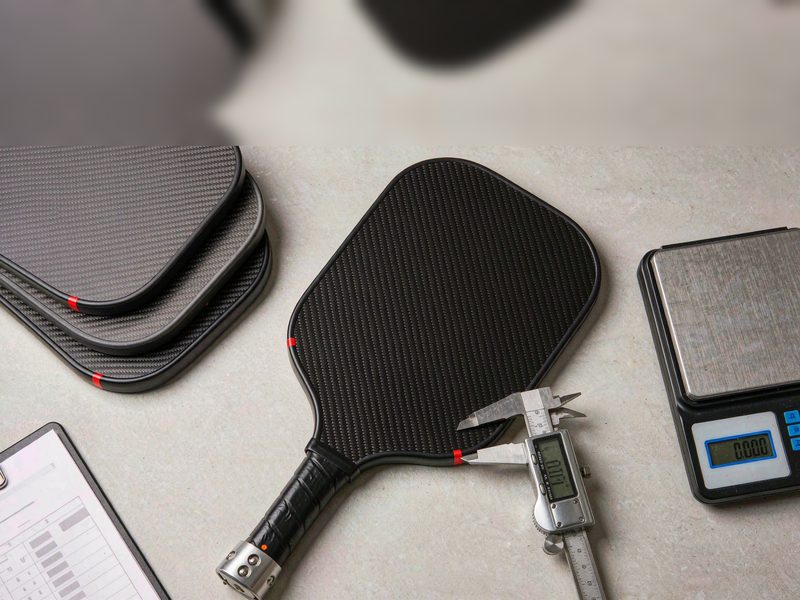
- Nine of the ten checks that matter need no lab — a kitchen scale, calipers, a flat table and a phone camera cover them.
- The most predictive checks: weight against spec, thickness across the face, edge guard bonding, face symmetry and texture consistency.
- A perfect single sample proves little. Samples get maximum attention; production doesn’t. Lock the approved unit as the golden sample and put inspection against it in writing.
- How a factory responds to a failed check tells you more than the check. Root cause plus corrective action is a supplier; a replacement without explanation is a risk.
Every sourcing guide tells you to order samples. Almost none tell you what to do with them when they arrive — so buyers tap the face a few times, play a set, and either wire the deposit or move on. That process misses the checks that actually predict what a 500-unit production run will look like, because the sample isn’t testing the paddle. It is testing the factory.
This checklist comes from the manufacturing side: these are the checks our own QC runs on every order, which means they are also the checks a buyer can run — or ask for the records of — before committing. It pairs with our guides to choosing a manufacturer and how paddle MOQs work.
Before the first check: get the sample round right
Two decisions made before samples ship determine whether the whole exercise means anything:
- Ask for three units of the same model, from the same run. A single sample is a showcase. Three units expose the batch tolerance — and tolerance is what you are actually buying in bulk. If a factory resists sending three, that resistance is information.
- Agree in writing that the approved sample becomes the golden sample. The unit you sign off is the physical reference for production inspection. Without this, “same as the sample” is a promise, not a specification.
The ten checks
1. Weight against specification
Put each unit on a kitchen scale that reads to 1 gram. Compare to the quoted figure — and compare the three units to each other. Spread between them is the factory’s real tolerance, whatever the spec sheet claims. A spread over roughly 10 grams on the same model is a red flag for ungraded packing.
2. Thickness across the face
Calipers, five points: center, four corners of the hitting area. Production paddles vary slightly, but visible steps between points mean core or press problems that get worse with use, not better. Record the numbers — this is the single best predictor of how the paddle will age.
3. Face symmetry and flatness
Lay the paddle on a flat table, face down. Rock it. A paddle that rocks has warp from uneven curing or post-mold handling. Then measure both faces: the two halves should mirror each other within a fraction of a millimeter. Asymmetric faces play inconsistently and can’t be fixed later.
4. Edge guard bonding
Press firmly along the entire edge with a thumbnail, looking for lifting, gaps or glue squeeze-out. The edge guard is the first failure point in real use — paddles die from edge separation long before cores fail. On thermoformed unibody paddles, the edge should be a continuous molded surface, not a bonded strip.
5. Surface texture consistency
Fingernail drag across the whole face. The grip should be even; glossy patches or smooth bands mean coating variation, and on printed faces, texture buried in ink that will wear. This check takes ten seconds and predicts how the paddle will play in six months better than almost anything else.
6. Sound across the face
Tap with a knuckle from center to edge. A consistent note means a well-bonded laminate. Dead or dull zones mean delamination — either a defect or the beginning of one. Every factory QC uses this check precisely because it is fast and honest.
7. Handle connection
Grip the face in one hand, the handle in the other, and apply firm twisting force. Any flex, click or creak at the throat is a structural fail. Handle breakage is the most warranty-generating defect in the category, and this test catches it in ten seconds.
8. Graphics and finish quality
Under good light, look for print registration errors, bubbles under the clear coat, alignment of logos to the edge, and end-cap seams. These are the defects customers photograph for reviews. Whatever you see in the sample, imagine 8% of production units slightly worse.
9. Playing test — structured, not casual
Play with all three units in the same session, in the same conditions. Note power, touch and vibration differences between them — inconsistency across your three samples is the bulk-order experience in miniature. Bring a reference paddle you know well as the control.
10. Packaging and documentation
Check the paddle cover fit, sleeve quality and carton spec. Then check what came with the samples: a spec sheet, actual measured values, inspection records. A factory that documents samples voluntarily will document production; one that ships samples bare will ship containers bare.
| # | Check | Tool | Fail signal |
|---|---|---|---|
| 1 | Weight vs spec | 1 g scale | >10 g spread between units |
| 2 | Thickness ×5 points | Calipers | Visible steps between points |
| 3 | Flatness / symmetry | Flat table | Rocking; asymmetric faces |
| 4 | Edge guard bonding | Thumbnail | Lifting, gaps, squeeze-out |
| 5 | Texture consistency | Fingernail | Glossy or smooth bands |
| 6 | Sound map | Knuckle | Dead or dull zones |
| 7 | Handle connection | Hands | Flex, click, creak at throat |
| 8 | Graphics / finish | Good light | Registration errors, bubbles |
| 9 | Playing consistency | Court + control paddle | Units feel different from each other |
| 10 | Packaging & docs | — | No measured values or records |
Samples are built under maximum attention — the best operator, watched materials, the run someone cares about. Production is built by the shift average. That is why the three-unit consistency check matters more than any single result, and why the golden-sample agreement matters more than both: it converts what the factory can do into what it owes you.
What to do when a check fails
This is the most diagnostic moment in the whole relationship, and most buyers handle it backwards. The instinct is to ask for a replacement sample. The better move is to ask for root cause and corrective action in writing:
- A supplier answers: “Thickness variation at point 3 traced to core sheet lot X; lot quarantined; incoming inspection tightened for your material spec.” That is a manufacturer — problems get found, owned and closed.
- A risk ships a new sample the next week with no explanation. The defect you found still exists in the process; it just didn’t land in this box.
The response to a failed check is the cheapest factory audit you will ever run.
After approval: keeping the bulk order honest
- Golden sample sealed and dated — one copy with you, one at the factory, referenced in the purchase order.
- Inspection criteria in the PO: the checks above, with numeric limits where possible (weight band, thickness tolerance, AQL level for the pre-shipment sampling).
- Pre-shipment inspection — factory-run report with photos as standard; independent third-party inspection for a first order, since self-inspection has an obvious conflict of interest. The equipment rules your paddles may be tested against — dimensions, surface, deflection — are published by USA Pickleball, and performance-oriented buyers increasingly check them, so test to the same bar before shipping.
- Retain production units from the batch — ask the factory to pull and keep two random units per order. When a customer dispute arrives months later, those retained samples are the evidence either way.
Frequently asked questions
How many samples should I request before a bulk paddle order?
At least three of the same model from the same run. One sample shows what the factory can do when it tries; three show what it does by default. The spread between them is the real test.
What should I check on a pickleball paddle sample?
Weight against spec, thickness at five points, flatness and face symmetry, edge guard bonding, texture consistency, sound map, handle connection, graphics quality, structured play test, and packaging with documentation. All but the last need no more than a scale, calipers and a table.
Can a sample be too good?
Yes — samples are built under maximum attention and represent the ceiling, not the average. Compensate with the three-unit consistency check and a written golden-sample agreement covering production.
How long does paddle sampling take?
Stock samples ship in days. Custom samples with new graphics or tooling typically take one to two weeks after design confirmation. Fully custom builds quoted suspiciously fast deserve questions about what was actually customized.
Should I get third-party inspection even after approving samples?
For a first bulk order, yes — pre-shipment inspection against the golden sample removes the conflict of interest in self-inspection and costs little relative to the order. Relax it later once the relationship has earned it.
Want to run this checklist on our samples?
Order a sample set — three units of the same model — and put the checklist to work. We will include the measured values for each unit, so you can check our numbers against yours.