




Blog
Pickleball Paddle Cores: Honeycomb, Foam and Thickness

Paddle Technology
Pickleball Paddle Core Materials Explained: Honeycomb, Foam and What Thickness Really Does
Quick answer
- Polymer honeycomb dominates for good reason: consistent, quiet, moisture-stable and manufacturable at scale.
- Thicker cores (14–16mm) bend more — more dwell, more control, larger trampoline feel. Thinner cores (10–13mm) are stiffer — faster response, more direct power, smaller margin for error.
- Foam cores are having a real moment in premium paddles: damping, stability and edge-wall reinforcement rather than raw pop.
- Core crush is the failure mode that matters: it is caused by cell wall fatigue, and cell size is one of its controlling variables — which retail pages never mention.
- If a brand cannot tell you the cell size and density of its core, it did not engineer the core — it bought it.
Ask ten paddle players what is inside their paddle and most will say "polymer honeycomb." Ask what the honeycomb's cell size is, or why their 16mm paddle feels softer than a friend's 13mm, and the answers get vague — because almost no retail page explains the core beyond a thickness number. This is the explanation from the factory side.
The three core families
Polymer honeycomb — the industry default
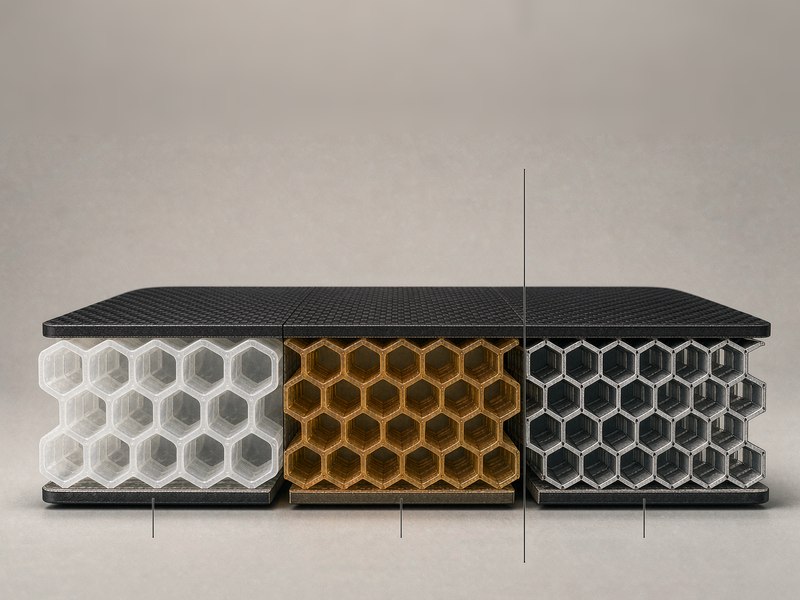
Polypropylene honeycomb is a sheet of hexagonal plastic cells bonded between the face sheets. It is used in the overwhelming majority of paddles because it balances everything a mass-produced paddle needs: consistent density from sheet to sheet, excellent moisture resistance, natural damping that keeps the paddle quiet, and stable behavior through thousands of press cycles.
The variables inside "polymer honeycomb" that actually change play:
- Cell size. Smaller cells mean more cell walls per square centimeter — a slightly stiffer, more precise feel. Larger cells feel softer and more forgiving. Retail pages almost never publish cell size, which is exactly why you should ask a manufacturer for it.
- Density. Higher-density honeycomb resists crushing better and firms up the response; lower density increases dwell time and softness.
- Grade. Honeycomb is manufactured in grades with real consistency differences. Budget paddles often run bottom-tier core stock, which is one reason two "16mm polymer" paddles can play nothing alike.
Foam — the premium damping play
Foam cores (usually polyurethane or EVA-family) have moved from niche to premium as brands chase pliability and stability. Foam does not honeycomb's job better — it does a different job. It damps vibration more completely, which softens impact and stabilizes the face at off-center contact. Many current flagship designs use foam selectively: a foam perimeter inside a honeycomb core to stiffen the edge wall, or foam-dominant constructions aimed at control players.
The trade-offs are real: foam costs more, is fussier to bond, and behaves differently under heat — which matters if a paddle sits in a car trunk in summer. Foam is not automatically "better"; it is a different contract between paddle and player.
Nomex and aluminum honeycomb — the legacy materials
Nomex (aramid honeycomb) was the early tournament core: extremely stiff, loud, and unforgiving. Aluminum honeycomb shares the stiffness with a metallic feel. Both have largely lost market share to polymer and foam because modern play favors damping and quiet — but you will still find them in power-oriented designs, and a factory that can work both materials honestly is telling you something about its process range.
Thickness: the number everyone quotes, explained properly
Core thickness changes how much the face can flex at contact. The physics in one paragraph: a thicker core allows more bending, which increases dwell time and the trampoline effect — more control and a softer, plusher feel. A thinner core resists bending, sending energy back faster — more direct power, crisper response, but less margin when contact is off-center.
| Thickness | Feel | Plays best for |
|---|---|---|
| 10–12mm | Stiff, fast, direct | Power players who hit the center |
| 13–14mm | Balanced | All-court players — the volume segment |
| 15–16mm | Soft, dwell, forgiving | Control players and anyone who values touch |
You will find pages claiming specific cores add 12–18% power or 30% durability. Those numbers have no standardized test behind them — no ball speed protocol, no machine, no condition control. Judge thickness by its mechanism (bending and dwell), not by invented percentages.
Core crush: the failure mode worth knowing
"Core crush" is when the honeycomb cells collapse under repeated impact, producing dead spots and a hollow sound. It is a fatigue failure of the cell walls, which means three variables control it: cell wall material grade, cell size, and how hard the face sheets are bonded to the core. This is why cell size is not trivia — a core with larger cells puts more span between walls, concentrating stress. When you compare paddles that feel dead after six months versus two years, the core spec is usually the difference.
For brands: this is also the question that separates manufacturers from resellers. Ask a supplier for cell size and density. If the answer is "high quality honeycomb," they did not engineer the core — they bought it. Our manufacturer selection checklist includes this among the five process questions.
How a factory decides core for your paddle
When a brand comes to us with a target player and price point, the core decision follows a simple logic:
- Control-positioned paddle, $130+ retail: 16mm polymer honeycomb, mid-density, fine cell — possibly with a foam perimeter.
- All-court mid-market workhorse: 13–14mm polymer honeycomb, standard grade. This is where volume lives.
- Power paddle: 10–13mm, stiffer core grade, sometimes hybrid with foam in the edge wall for stability without softness.
The core never decides alone — it works with the face. The same 14mm core plays completely different under a fiberglass face versus a raw carbon face, which is why the two decisions should be made together. We break down the face side in carbon fiber vs fiberglass faces.
Specifying a core for your own paddle?
Tell us your target player and price band. We will propose core material, thickness and density with the reasoning — before you commit to tooling.
Contact Us for a QuoteFrequently asked questions
What is the best core material for a pickleball paddle?
For most players, mid-density polymer honeycomb — it balances consistency, damping, durability and cost. Foam adds damping and stability at premium price points; Nomex and aluminum cores survive mainly in power-focused designs.
Does a thicker core really mean more control?
Yes, as a mechanism: a thicker core allows more face bending, longer dwell and a plusher feel. It is a trade — thicker cores give up some direct power and add swing weight, which some players dislike.
What is core crush and can it be prevented?
Core crush is the collapse of honeycomb cells under repeated impact, creating dead spots. It is controlled by core grade, cell size and bonding quality — three specification-level choices, which is why cheap cores fail first.
Why does cell size matter if nobody publishes it?
Cell size changes the ratio of cell walls to open area, affecting stiffness, feel and crush resistance. Retail pages skip it because it is inconvenient; manufacturers specify it because it is real.
Are foam core paddles worth the premium?
For players who prioritize damping, stability and off-center forgiveness — often yes. For maximum pop and low price, polymer honeycomb remains the rational choice.