




Blog
Carbon Fiber vs Fiberglass Paddle Faces: Full Comparison

Paddle Technology
Carbon Fiber vs Fiberglass Paddle Faces: What the Face Material Actually Changes
Quick answer
- Carbon fiber faces are stiffer and lighter: more energy returned, more consistent response, the material of performance paddles.
- Fiberglass faces flex more: longer dwell, more forgiving on off-center hits, dramatically cheaper — the honest workhorse material.
- Kevlar / aramid is a niche face material prized for damping and durability, not for the "maximum spin" marketing attached to it.
- Surface texture — not the fiber — creates spin. Texture comes from the peel-ply process or applied coating, which is why a "raw carbon" paddle is textured and a glossy carbon paddle is not.
- For brands: the face decision is a pricing decision. The bill-of-materials gap is a few dollars; the retail gap is $40–80.
Face material is the most oversold variable in paddle marketing and one of the most consequential in paddle engineering. Both statements are true. Here is what changes mechanically when you swap a face — and what does not.
Carbon fiber: stiffness is the whole story
Carbon fiber's defining property is high stiffness at low weight. Under impact, a stiff face deforms less and returns energy faster — the response is direct, and the paddle plays consistent from center to edge. Stiffness is also why carbon dominates at the top of the market: better energy transfer and lighter weight let designers spend the saved grams elsewhere (a thicker core, a longer handle).
What carbon does not do automatically: forgive. A stiff face corrects nothing. Off-center hits feel like off-center hits. Combined with the thicker, softer cores it usually pairs with, carbon paddles get their forgiveness from the core, not the face.
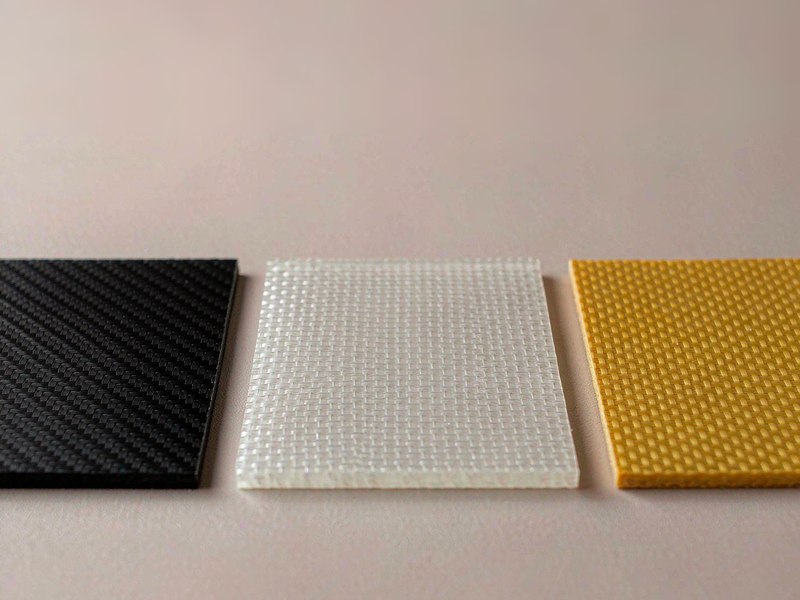
Carbon faces come in weave grades and finishes — 3K twill is the familiar pattern, heavier tows like 12K and 18K appear in power paddles, and "raw carbon" refers to an untinted, textured carbon surface rather than a different fiber. If you have read that T700 and "3K" are competing materials, that is a category error: T700 is a fiber grade, 3K is a tow size, and the same fiber can be woven into either. A factory buying certified fiber grade lots can show you the difference a spec sheet makes.
Fiberglass: the physics of forgiveness
Fiberglass (glass-reinforced plastic) has lower stiffness than carbon — roughly a third of the modulus, in round numbers. That sounds like a defect until you see what it buys: the face bends more at contact, holds the ball longer, and trampolines softer. On off-center contact that flex absorbs error instead of punishing it.
This is why fiberglass remains the right answer for a huge slice of the market: beginners, casual players, youth programs, and any brand building a $60–80 paddle that has to feel pleasant, not professional. It is also dramatically cheaper and easier to bond — fewer process variables to control.
The honest limitation: fiberglass is heavier per equal stiffness, and it absorbs more impact energy. Players with fast, compact swings who live on reaction speed will feel the ceiling. Our fiberglass line exists precisely for that middle segment — see the fiberglass paddle range for how we position it.
Kevlar and aramid: damping, not spin
Aramid fibers (Kevlar is the famous brand name) show up in premium faces for one mechanical reason: they absorb vibration exceptionally well. A carbon-aramid hybrid face damps harshness while keeping most of carbon's response — a genuinely useful tool for players with arm sensitivity.
The marketing claim to ignore: "Kevlar for maximum spin." Spin comes from surface texture and friction against the ball, and aramid fibers have no special texture advantage. The claims that survive contact with the court are durability and damping — which are real and worth paying for, just not for the stated reason.
Spin comes from the surface, not the fiber
The most useful fact in this entire article: face texture is a manufacturing process, not a material property. When carbon cloth cures against a peel ply, the woven imprint of that ply transfers to the paddle surface — that is the "raw carbon texture" everyone sells. The same carbon fiber without the peel ply cures glossy and slick.
Practical consequences:
- A textured fiberglass paddle can out-spin a glossy carbon paddle. The fibers are irrelevant; the surface is not.
- Texture wears. Peel-ply texture sits at the surface and flattens with play; coatings can be re-applied. Ask how a surface maintains its texture over months, not out of the box.
- Two ways to check texture honestly: drag a fingernail across the face (you should feel resistance) and ask whether the texture is molded-in or sprayed-on. Sprayed grit looks identical on day one and disappears by month three.
Side by side
| Carbon fiber | Fiberglass | Aramid / Kevlar | |
|---|---|---|---|
| Stiffness | High | Moderate | High (damping) |
| Feel | Direct, consistent | Soft, forgiving | Smooth, muted |
| Weight efficiency | Best | Heaviest per stiffness | Good |
| Cost | Highest | Lowest | Premium |
| Typical retail tier | $120–250 | $50–90 | $150–220 |
| Best for | Performance players | Beginners, volume lines | Arm comfort, durability niches |
For brands: the face is a pricing decision
Here is the uncomfortable arithmetic. The bill-of-materials difference between a fiberglass face and a 3K carbon face is a few US dollars per paddle. The retail positioning difference is $40–80. That spread is why "carbon fiber" is stamped on paddles that barely qualify — and why a brand that verifies face material (ask for the weave spec and a cross-section photo) earns durable trust with buyers who can tell the difference.
A sensible first line pairs one fiberglass workhorse with one 3K carbon all-court model and, at most, one raw-carbon flagship. The face works with the core, not instead of it — the pairing logic is in our core materials guide. And when you brief the factory, put the face spec in the sheet exactly as you would for OEM tooling; the model comparison in OEM vs ODM vs private label explains who owns what at each manufacturing model.
Deciding between carbon and fiberglass for your line?
Send us your price band and target player. We will quote both constructions with the same core so you can compare honestly.
Contact Us for a QuoteFrequently asked questions
Is a carbon fiber paddle face really better than fiberglass?
Better for performance play — stiffer, lighter, more consistent. Not better for everyone: fiberglass flexes more, forgives off-center hits and costs far less. The right question is which behavior fits your player.
Do carbon fiber paddles have more spin?
Not because of the fiber. Spin comes from surface texture, which is created by the peel-ply process or coatings and can be applied to any face material, including fiberglass.
What does a Kevlar paddle face actually do?
Aramid fibers damp vibration exceptionally well, so carbon-aramid hybrids smooth harshness while keeping most of carbon's response. Durability is also real. The "maximum spin" claims are marketing.
How can I tell if a paddle really has a carbon face?
Ask for the weave specification and a cross-section photo, and weigh the paddle — genuine carbon faces contribute to notably light builds. A factory willing to spec the material will document it.
Why are carbon paddles so much more expensive?
Material cost is only part of it — carbon demands tighter process control in layup, pressing and finishing. The larger driver is positioning: the retail gap between fiberglass and carbon is much wider than the bill-of-materials gap.